The Most Expensive Auction on the Internet
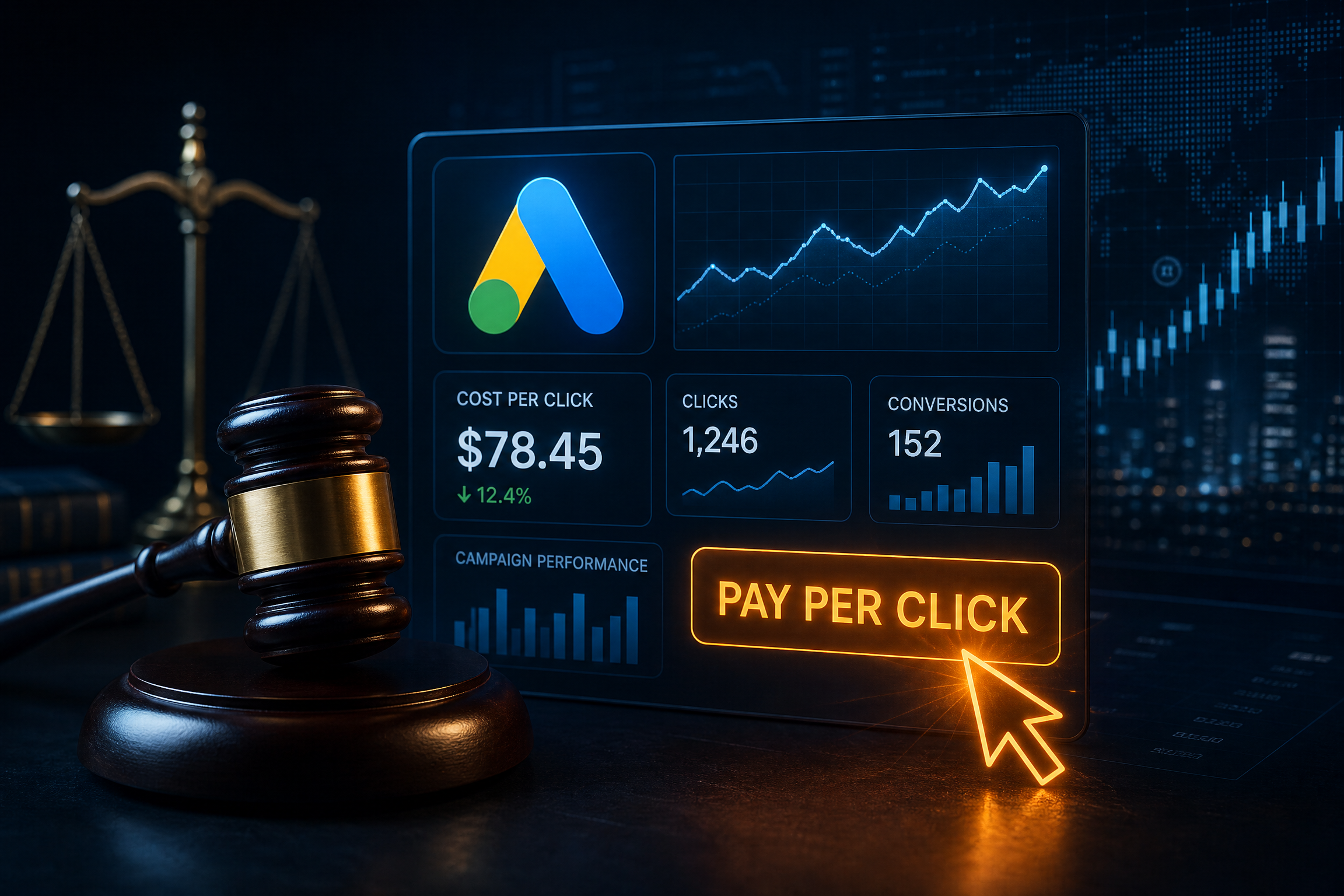
If you are managing a personal injury law firm, you already know that client acquisition is expensive. But until you look under the hood of a live Google Ads campaign, it is difficult to grasp just how punishing the pay-per-click (PPC) landscape has become. Data published by Rankings.io in March 2026 confirms that standard keywords like "car accident lawyer" routinely cost $150 or more per click. High-value queries like "truck accident attorney" can push $300, and in hyper-competitive major metros, top personal injury terms regularly exceed $500 for a single click.
At those prices, the margin for error is zero. If it takes 10 clicks to generate one qualified lead, a $150 cost-per-click (CPC) translates to a $1,500 cost-per-lead (CPL). If you close one out of every three leads, your cost-per-acquisition (CPA) is $4,500. For a catastrophic injury case, a $4,500 acquisition cost is a massive win. But if that same budget is accidentally spent on clicks from people looking for a "pro bono traffic ticket lawyer," you are bleeding cash with nothing to show for it.
Despite the costs, law firm PPC remains one of the most powerful levers for growth because it buys you the one thing SEO cannot: immediate, top-of-page visibility for high-intent queries. However, running a profitable campaign in 2026 requires understanding that Google Ads is not a flat marketplace. Two law firms bidding on the exact same keyword in the exact same city will often pay wildly different amounts per click. The difference comes down to execution, Quality Score, and adapting to Google's new AI-driven search reality.
The Hidden Tax: Why Quality Score Dictates Your Profitability
The most dangerous misconception in personal injury marketing is that the highest bidder always wins the top ad spot. Google Ads uses an auction system, but your position is determined by Ad Rank, which is your maximum bid multiplied by your Quality Score. Quality Score is Google's internal 1-to-10 rating of how relevant and useful your ad experience is to the user.
Because PI clicks are so expensive, Quality Score acts as a massive financial multiplier. A firm with a Quality Score of 8 on a $150-per-click keyword receives a discount, paying approximately $94. A competing firm with a Quality Score of 3 pays a penalty, bringing their cost for that exact same click to $251. That is a $157 difference per click, based entirely on campaign quality. Over a month of 500 clicks, the firm with the higher Quality Score saves over $78,000.
Google calculates Quality Score using three primary factors: expected click-through rate (CTR), ad relevance, and landing page experience. Personal injury firms structurally struggle with all three unless they are intentionally optimized.
1. Expected Click-Through Rate (CTR)
Expected CTR measures how likely a user is to click your ad compared to competitors. Because PI advertising is saturated, earning the click is difficult. Generic headlines like "Experienced Personal Injury Attorney" do not stand out. High-CTR ad copy must lead with social proof ("Over $500M Recovered"), speak directly to the user's specific situation ("Hit by a Commercial Truck?"), and eliminate friction ("Free Consultation. No Fee Unless You Win").
2. Ad Relevance and Tightly Themed Ad Groups
Ad relevance measures how closely your ad matches the user's search intent. The most common mistake PI firms make is dumping all their keywords into one broad campaign and serving the same generic ad to everyone. If a user searches for "motorcycle accident lawyer" and sees an ad that just says "Personal Injury Law Firm," Google penalizes the ad relevance. Profitable campaigns use tightly themed ad groups: a specific ad group for motorcycle accidents, another for slip-and-falls, and another for truck accidents, each with bespoke ad copy matching the query perfectly.
3. The Landing Page Penalty
This is where the most money is wasted. The vast majority of law firms send all their expensive PPC traffic to their website's homepage. A homepage is designed to introduce the firm; it is full of navigation links, practice area menus, and firm history. A landing page should have exactly one purpose: converting a high-intent visitor into a phone call or form submission.
When you send a $200 click to a slow-loading homepage where the user has to hunt for a phone number, they will bounce. Google sees this immediate bounce, downgrades your landing page experience score, drops your Quality Score, and increases your CPC. Every ad group must direct traffic to a dedicated, lightning-fast landing page built specifically for that case type, with no external navigation to distract the user.
| Quality Score | Financial Impact on a $150 Keyword | Effective Cost Per Click |
|---|---|---|
| Score of 10 | 50% Discount | $75.00 |
| Score of 8 | 37% Discount | $94.50 |
| Score of 5 | Baseline (No penalty or discount) | $150.00 |
| Score of 3 | 67% Premium Penalty | $251.00 |
| Score of 1 | 400% Premium Penalty | $750.00 |
How AI Overviews Are Disrupting Paid Search
The mechanics of Google Ads are changing rapidly in 2026 due to the rollout of AI Overviews (AIO). When a user asks a complex legal question, Google often generates a comprehensive AI summary at the top of the page. This pushes traditional search ads further down the screen, particularly on mobile devices.
The impact on click-through rates is severe. According to a September 2025 study by Seer Interactive, when an AI Overview appears on a search results page, the CTR for paid ads drops from an average of 19.70% down to 6.34%. Furthermore, data from LLMrefs indicates that over 80% of searches now end without a user clicking through to any website at all. Users are getting their answers directly from the AI and leaving.
For personal injury marketers, this means top-of-funnel, educational keywords (e.g., "what is the statute of limitations for a car accident") are becoming less viable for PPC. The AI answers those questions instantly, and your ad goes unseen. To maintain profitability, PI budgets must be aggressively pivoted toward bottom-of-funnel, high-intent queries (e.g., "hire a car accident lawyer near me") where AI Overviews are less likely to fully satisfy the user's need to actually speak with an attorney.
Additionally, Google is expanding ad eligibility directly into AI Overviews via Performance Max and AI Max for Search. To qualify for these new conversational ad placements, your campaign must provide Google's algorithm with rich, structured data and clean conversion signals, which is why advanced programmatic strategies and robust CRM integrations are no longer optional.
PPC vs. LSA vs. SEO: The 2026 Acquisition Stack
A common question from managing partners is whether they should shift their budget entirely away from PPC and into Local Services Ads (LSAs) or SEO. The reality is that these three channels serve different functions and work best when layered together.
- Local Services Ads (LSA): These appear at the very top of the page with a "Google Screened" badge. You pay per lead (phone call or message) rather than per click. They are excellent for generating immediate trust and phone calls, but you have very little control over targeting or volume. You cannot force Google to show your LSA more often just by raising your budget.
- Pay-Per-Click (PPC): Traditional Google Ads give you total control. You dictate exactly which keywords trigger your ads, which geographic radiuses you target, and what the ad copy says. It is the most scalable way to generate cases on demand, provided your campaign is optimized to handle the high CPCs.
- Search Engine Optimization (SEO): Personal injury SEO is a long-term asset. It requires significant upfront investment in content, technical architecture, and off-page authority, but it compounds over time. Once you rank organically, you do not pay for each click.
The most profitable PI firms in 2026 do not choose between them; they dominate all three. They use LSAs to capture immediate local trust, PPC to aggressively target specific high-value case types (like commercial trucking or traumatic brain injuries), and SEO to build a sustainable foundation of organic traffic that lowers their blended cost-per-acquisition.
Stop Wasting Your Marketing Budget
Running a personal injury Google Ads campaign without dedicated landing pages, strict negative keyword lists, and a relentless focus on Quality Score is the fastest way to burn through your marketing budget. In a landscape where a single click can cost $200 and AI Overviews are compressing ad visibility, precision is the only path to profitability.
At Marketing for Justice, we specialize in high-performance digital acquisition for personal injury law firms. We don't just bid on keywords; we engineer the entire conversion funnel—from high-CTR ad copy to conversion-rate-optimized landing pages—ensuring you pay the lowest possible CPC while capturing the highest-quality cases.
If you are tired of overpaying for unqualified clicks or want to know exactly how much budget your current campaigns are wasting, contact Marketing for Justice today for a free strategy call and PPC audit. We will review your current metrics, identify your Quality Score penalties, and show you exactly how to turn your ad spend into signed cases.

Dan Brian
CEO, Marketing for JusticeDan Brian is the CEO of Marketing for Justice, a full-service digital marketing agency exclusively serving consumer-facing law firms. With over two decades of experience in legal marketing, Dan specializes in SEO, GEO, PPC, and intake optimization for personal injury, family law, criminal defense, and other consumer-facing practice areas. He writes and speaks regularly on the intersection of AI search and legal marketing.